How product labeling works in a warehouse, step by step

Labeling sounds like the simplest part of the whole operation, until it is the reason a marketplace rejects your shipment or 5,000 imported units cannot go on sale. A product labeling service exists to solve exactly that: every unit gets the label it is missing, without your team spending the week applying them.
What a product labeling service is
It is applying, in a warehouse and at scale, the label each unit needs in order to be sold or moved: a barcode, a brand label over generic packaging, the label of the marketplace where it will sell, a Spanish-language label for imported product, or a lot label. The operator does not design the label or decide what it must say; it applies it with the information and inputs you hand over.
When it is needed
| Case | What gets labeled | Typical example |
|---|---|---|
| Imported product | Spanish-language label with the content your regulatory team defines | A container that arrives labeled in another language and cannot be sold that way. |
| Marketplace sales | Per-unit and per-box labels the marketplace requires | Prepping 1,200 units to enter a marketplace fulfillment program. |
| Private label or contract manufacturing | Brand label over generic packaging | Product that arrives in a plain box and leaves under your brand. |
| Retail | Label and requirements of the chain | A department-store order with its own label format. |
| New presentation | Repackaging plus a new label | Going from single units to a three-pack with its own code. |
What you provide and what the operator provides
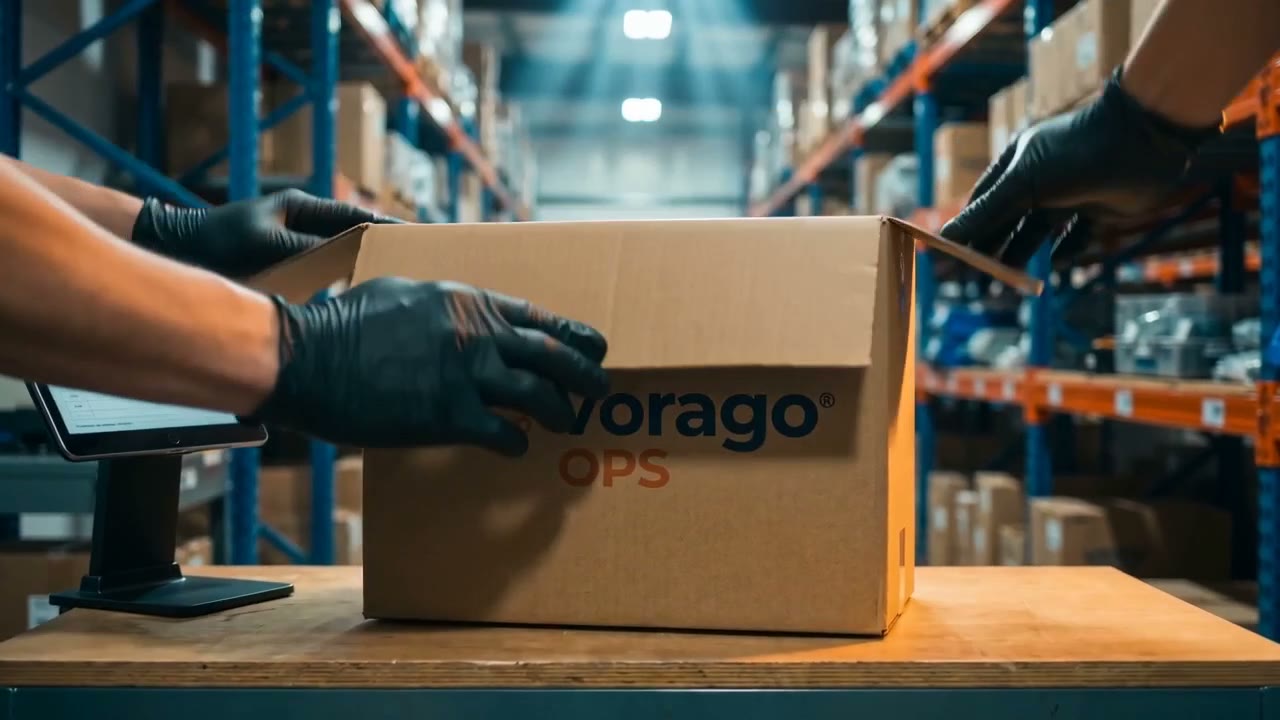
You hand over the label content (artwork, file or already-printed labels) and define which unit gets which. The operator receives the product, unpacks it if needed, applies the label in the agreed position, checks it and repacks. Responsibility for the label complying with the standard that applies to your product belongs to the brand owner; a good operator tells you that up front instead of promising to "take care of everything".
How labeling is priced
It is priced per unit. What moves the price: how many labels each piece carries, whether it has to be unpacked and repacked to apply them, whether it is combined with kit assembly, and the total batch size. A batch of 10,000 units with one label each costs less per unit than 500 units with three labels and repackaging.
When outsourcing it makes sense
- You import and the product needs a label before it can be sold.
- You sell on marketplaces and per-unit labeling is eating your team’s hours.
- You launch new presentations and need repackaging and labeling at the same time.
- The product already is (or will be) stored at the operator’s warehouse: it gets labeled there and ships straight out.
- Your sales or marketing team is applying labels instead of selling.
Common mistakes
- Sending artwork without checking it against what the marketplace or the standard requires: it gets labeled twice.
- Not testing a sample: some labels do not stick to certain packaging materials.
- Not marking the lot when the product needs it for traceability or returns.
- Labeling before quality control: the label is wasted on rejected units.
How we do it at VORAGO OPS
We repackage and label with the information and inputs you provide, and prep product for Amazon, Mercado Libre and Walmart, with piece-by-piece quality control. If the product is also stored with us, it gets labeled in the same warehouse and ships straight to its destination, with nationwide coverage. Every process is ISO 9001:2015 certified.
Ready to find out if a 3PL is right for you?
Tell us about your operation and we’ll deliver a free assessment with real numbers for your case.
Request an operational diagnosis